If you’re wondering how to learn digital marketing while managing work, studies, or everyday responsibilities, you’re probably not alone.
Digital marketing is a big field. There’s SEO, social media, Google Analytics, paid advertising, content marketing, website development, and now AI tools. Every time you open LinkedIn or YouTube, there’s something new to learn.
I’ve worked with different digital marketing tools and platforms throughout my career, from my early experience in Nepal to my current work in the United States. One thing I’ve realized is that learning more doesn’t always mean spending more time studying.
Sometimes, it means focusing on one skill, practicing it, and understanding what you’ve learned.
That’s the idea behind this simple weekly learning system.
1. Focus on One Digital Marketing Skill at a Time
One common mistake when learning digital marketing is trying to learn everything together.
You might start watching an SEO tutorial, switch to Google Ads, explore an AI tool, and then spend another hour learning about social media algorithms.
All of these topics are useful, but switching between them can make it difficult to develop practical skills.
I prefer starting with one clear question.
For example:
- How can I understand where my website traffic comes from?
- How do I find keywords for a blog article?
- How can I measure whether a marketing campaign is working?
- What makes a website easier to use?
Once you have a question, choose the skill that helps you answer it.
If you’re interested in website traffic, start with Google Analytics 4. If you want to improve search visibility, explore Google Search Console.
You don’t need to master every feature. Start with what solves your immediate problem.
2. Learn by Doing, Not Just Watching Tutorials
Courses and YouTube videos are helpful. But watching someone else use a tool is different from using it yourself.
For me, practical work has been an important part of learning digital marketing.
Working with websites, analytics, SEO, and reporting has given me opportunities to apply what I learn and understand how different tools connect.
For example, if you’re learning keyword research, don’t stop after watching a tutorial.
Choose a topic, open Google Keyword Planner, research relevant keywords, and compare their search demand.
Then try writing an article around what you discovered.
If you’re learning analytics, explore a website’s reports and identify which information could help improve its content.
The goal isn’t to complete another tutorial. It’s to understand how to apply the skill.
If you’re unsure which tools to start with, I’ve shared seven free digital marketing tools worth learning first.
3. A Simple Seven-Day Digital Marketing Learning Plan
You don’t need several hours every day to make progress.
For someone balancing a job, classes, or other responsibilities, I recommend starting with 20–30 minutes of focused learning.
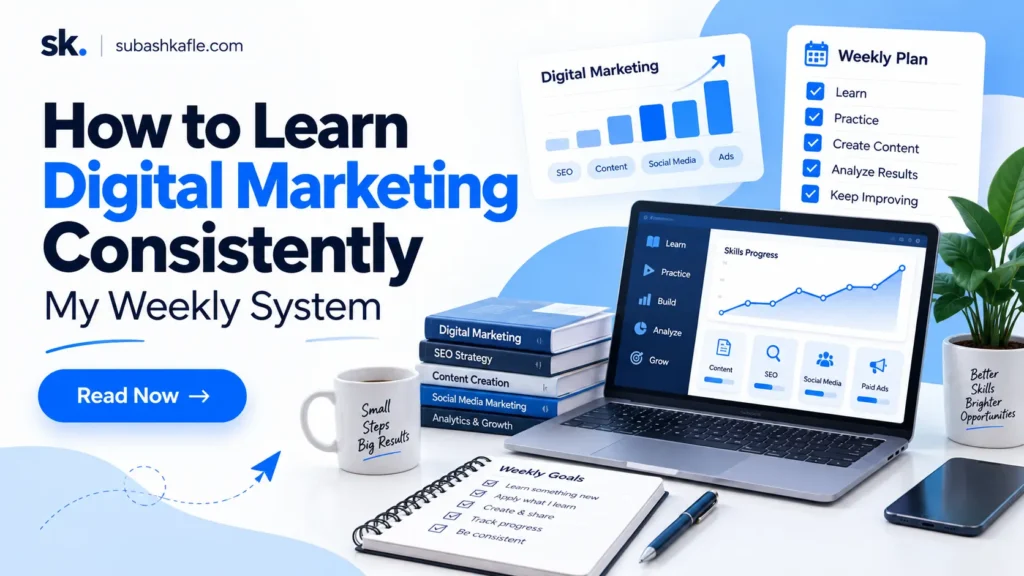
Here’s a weekly structure you can adapt to your schedule.
| Day | Learning Activity |
|---|---|
| Monday | Choose one skill and define a small learning goal. |
| Tuesday | Read a guide or watch a focused tutorial. |
| Wednesday | Practice the skill using a real or sample project. |
| Thursday | Continue practicing and solve one problem. |
| Friday | Apply what you’ve learned to a useful task. |
| Saturday | Document your work and organize your notes. |
| Sunday | Review your progress and choose next week’s focus. |
Let’s say your weekly topic is Google Search Console.
On Monday, your goal might be understanding how people find your website through Google.
By Wednesday, you could explore the Performance report and compare clicks, impressions, and search queries.
On Friday, you might identify one article that could benefit from a clearer title or more useful content.
By Sunday, you’ll have something more valuable than a collection of tutorial videos: practical experience with a specific tool.
The same approach can work for SEO, email marketing, website development, or campaign reporting.
4. Keep Your Learning Notes Simple
Another habit I recommend is documenting what you learn.
You don’t need a complicated productivity system.
A Google Doc, spreadsheet, or simple notes application is enough.
After each learning session, write down three things:
- What I learned: One new concept or feature.
- What I practiced: The task or example I worked on.
- What I need to understand next: One question to revisit.
These notes can become useful references when you encounter the same problem later.
They can also help you recognize progress that might otherwise be easy to overlook.
5. One Lesson From Building My Own Website
A recent example of learning through practical work is building content for my personal website.
I’ve been publishing guides about SEO, analytics, WordPress, and digital marketing tools.
Preparing these articles involves researching topics, checking technical information, working with WordPress, and explaining ideas in simple language.
One lesson I keep returning to is that understanding a tool and explaining its practical value are two different skills.
For example, learning where to find a website traffic report is useful. Understanding what that report can tell you, and what it cannot, is even more important.
That perspective is also part of my broader digital marketing career lessons.
Writing about what I know gives me another way to practice, document useful knowledge, and identify questions worth exploring further.
6. Make Consistency More Important Than Perfection
You won’t always have time to study every day.
Some weeks will be busy. Sometimes a task will take longer than expected. You might also discover that a subject is more complicated than you originally thought.
That’s normal.
Instead of trying to follow a perfect schedule, focus on keeping your learning manageable.
If you miss a day, continue where you left off.
If 30 minutes feels difficult, try 15 minutes.
And if one topic takes two weeks instead of one, give yourself enough time to understand it.
Consistency doesn’t mean learning something new every single day. It means continuing to make progress over time.
Final Thoughts: Start Small and Keep Learning
Digital marketing will continue changing. New tools will appear, platforms will evolve, and the skills employers value may shift.
But the ability to learn, practice, and adapt will always be useful.
My advice is simple: choose one skill, work on a practical example, document what you learn, and review your progress regularly.
You don’t need to know everything before starting.
Try the seven-day learning plan this week. Pick one digital marketing skill and give yourself a small, achievable goal.
And if you’d like to learn more about my background and professional journey, you can read my About page.
Sometimes, meaningful progress starts with one small lesson.
Choose Your First Digital Marketing Tool
Keep the conversation going.
Have a question or another perspective? Leave a thoughtful comment. Comments may be reviewed before appearing publicly.